The Exact Metrics Seed Investors Look for in AI & SaaS Startups Today
Raising a seed round is no longer just about having an impressive product or a large market opportunity. Investors want evidence that customers want the product, the business can grow, and the economics can eventually work at scale.
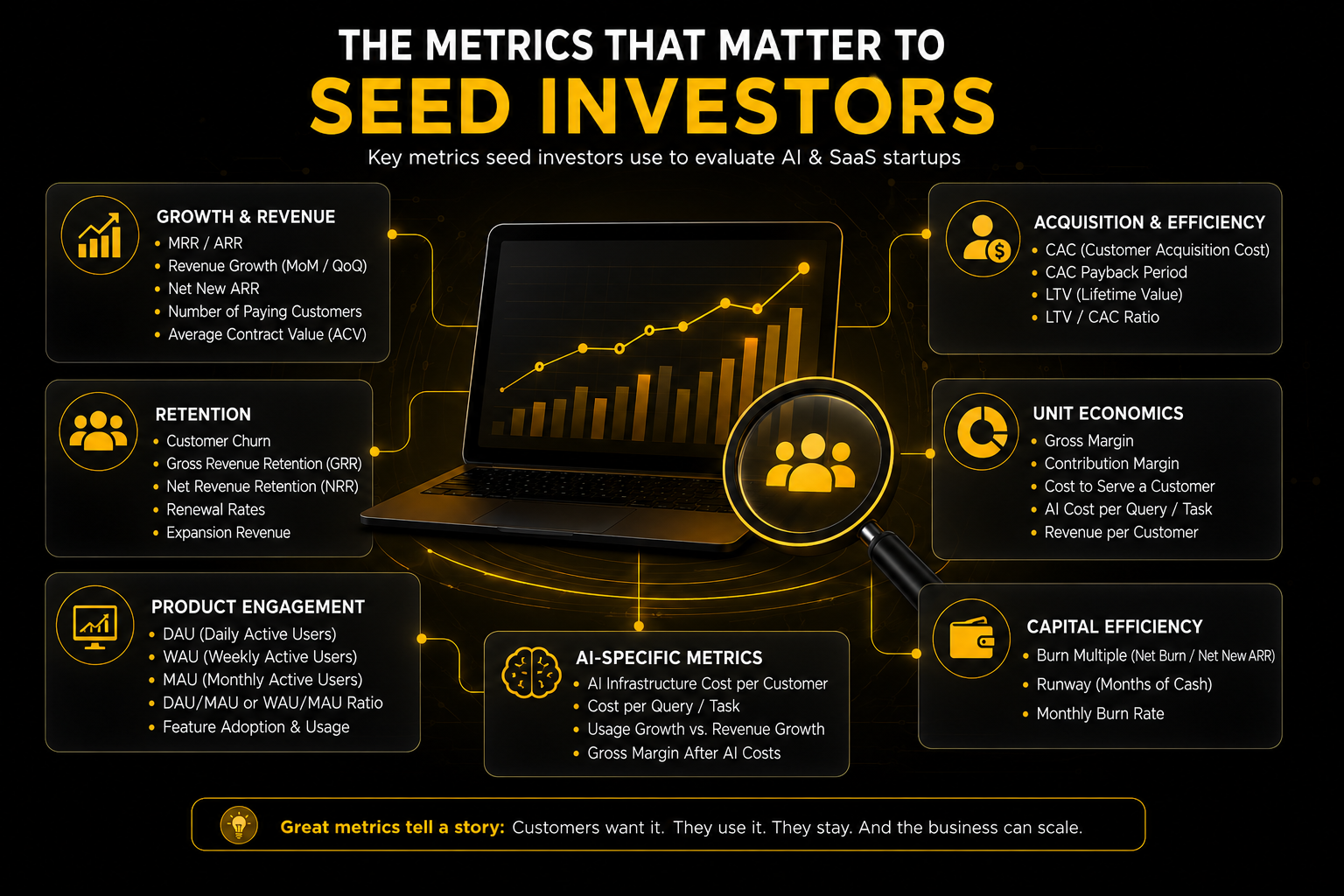
For AI and SaaS startups, these are the key metrics that matter.
1. ARR & MRR: Is There Real Revenue?
Monthly Recurring Revenue (MRR) and Annual Recurring Revenue (ARR) show whether customers are actually willing to pay.
Investors look beyond the revenue number itself. They want to see:
- Consistent revenue growth
- Increasing number of paying customers
- Average contract value
- Quality and predictability of revenue
At seed stage, there isn’t one universal ARR benchmark. Growth trajectory and revenue quality matter just as much as the current number.
2. Revenue Growth: Is the Business Gaining Momentum?
A startup generating revenue but growing slowly tells a different story from one showing consistent growth.
Track:
- Month-over-month growth
- Quarter-over-quarter growth
- Net new ARR
- Growth consistency
Investors want to understand whether your growth is becoming repeatable, rather than being driven by one-off wins.
3. Retention: Do Customers Stay?
Acquiring customers means little if they leave quickly.
Key SaaS metrics include:
- Customer churn
- Gross Revenue Retention (GRR)
- Net Revenue Retention (NRR)
- Renewal rates
- Expansion revenue
Strong retention demonstrates that customers are getting ongoing value from the product.
For investors, retention is one of the clearest indicators of product-market fit.
4. Product Engagement: Are Customers Actually Using It?
Especially for early-stage AI startups, engagement can be a powerful traction signal.
Track:
- DAU / WAU / MAU
- Usage frequency
- Feature adoption
- Active accounts
- Usage growth
Don’t focus only on total sign-ups.
500 highly engaged customers can be more valuable than 50,000 inactive users.
5. CAC: How Efficiently Can You Acquire Customers?
Customer Acquisition Cost (CAC) tells investors how much you spend to acquire each customer.
But the number needs context.
Investors will ask:
- Which channels bring your best customers?
- Is acquisition becoming cheaper?
- Is founder-led sales becoming repeatable?
- How does CAC compare with customer value?
A high CAC at seed stage isn’t automatically a red flag if there is a clear path toward improving efficiency.
6. CAC Payback & LTV: Does Growth Make Economic Sense?
Investors want to know whether the revenue generated by a customer can justify the cost of acquiring them.
Two important metrics are:
CAC Payback: How long it takes to recover customer acquisition costs.
LTV/CAC: The relationship between customer lifetime value and acquisition cost.
Together, they help investors understand whether growth can become economically sustainable.
7. Gross Margin: Can You Scale Profitably?
Gross margin is particularly important for AI startups.
AI products can carry significant costs from:
- LLM/API usage
- Cloud infrastructure
- GPU compute
- Data processing
- Model inference
Founders should know their cost to serve each customer and how that cost changes as usage increases.
Rapid AI usage is not necessarily good if costs grow faster than revenue.
8. Burn Multiple & Runway: Are You Using Capital Efficiently?
Investors also want to know what happens to the money they invest.
Burn Multiple = Net Cash Burn ÷ Net New ARR
A lower burn multiple generally indicates better capital efficiency.
Founders should also clearly understand:
- Monthly burn
- Cash runway
- Hiring costs
- Major expenses
- Milestones to achieve with the next round
The strongest fundraising story connects:
Capital → Milestones → Growth → Next stage
9. AI-Specific Unit Economics
For AI startups, one additional layer matters: AI economics.
Track:
- AI cost per customer
- Cost per query/task
- Revenue per customer
- AI infrastructure costs
- Gross margin after AI costs
- Usage growth vs. revenue growth
Investors want to know whether your AI business becomes more efficient as it scales—or more expensive.
Final Takeaway
Seed investors aren’t looking for perfect numbers. They’re looking for evidence of momentum and potential.
A strong AI or SaaS startup can demonstrate:
Real customers + growing revenue + strong retention + meaningful engagement + improving acquisition efficiency + sustainable unit economics.
Ultimately, your metrics should tell one clear story:
Customers want the product, they continue using it, and the business is learning how to grow efficiently.
That’s the story that turns startup metrics into an investable opportunity.