
The Exact Metrics Seed Investors Look for in AI & SaaS Startups Today
Raising a seed round is no longer just about having an impressive product or a large market opportunity. Investors want evidence that customers want the product, the business can grow, and the economics can eventually work at scale.
For AI and SaaS startups, these are the key metrics that matter.
1. ARR & MRR: Is There Real Revenue?
Monthly Recurring Revenue (MRR) and Annual Recurring Revenue (ARR) show whether customers are actually willing to pay.
Investors look beyond the revenue number itself. They want to see:
- Consistent revenue growth
- Increasing number of paying customers
- Average contract value
- Quality and predictability of revenue
At seed stage, there isn’t one universal ARR benchmark. Growth trajectory and revenue quality matter just as much as the current number.
2. Revenue Growth: Is the Business Gaining Momentum?
A startup generating revenue but growing slowly tells a different story from one showing consistent growth.
Track:
- Month-over-month growth
- Quarter-over-quarter growth
- Net new ARR
- Growth consistency
Investors want to understand whether your growth is becoming repeatable, rather than being driven by one-off wins.
3. Retention: Do Customers Stay?
Acquiring customers means little if they leave quickly.
Key SaaS metrics include:
- Customer churn
- Gross Revenue Retention (GRR)
- Net Revenue Retention (NRR)
- Renewal rates
- Expansion revenue
Strong retention demonstrates that customers are getting ongoing value from the product.
For investors, retention is one of the clearest indicators of product-market fit.
4. Product Engagement: Are Customers Actually Using It?
Especially for early-stage AI startups, engagement can be a powerful traction signal.
Track:
- DAU / WAU / MAU
- Usage frequency
- Feature adoption
- Active accounts
- Usage growth
Don’t focus only on total sign-ups.
500 highly engaged customers can be more valuable than 50,000 inactive users.
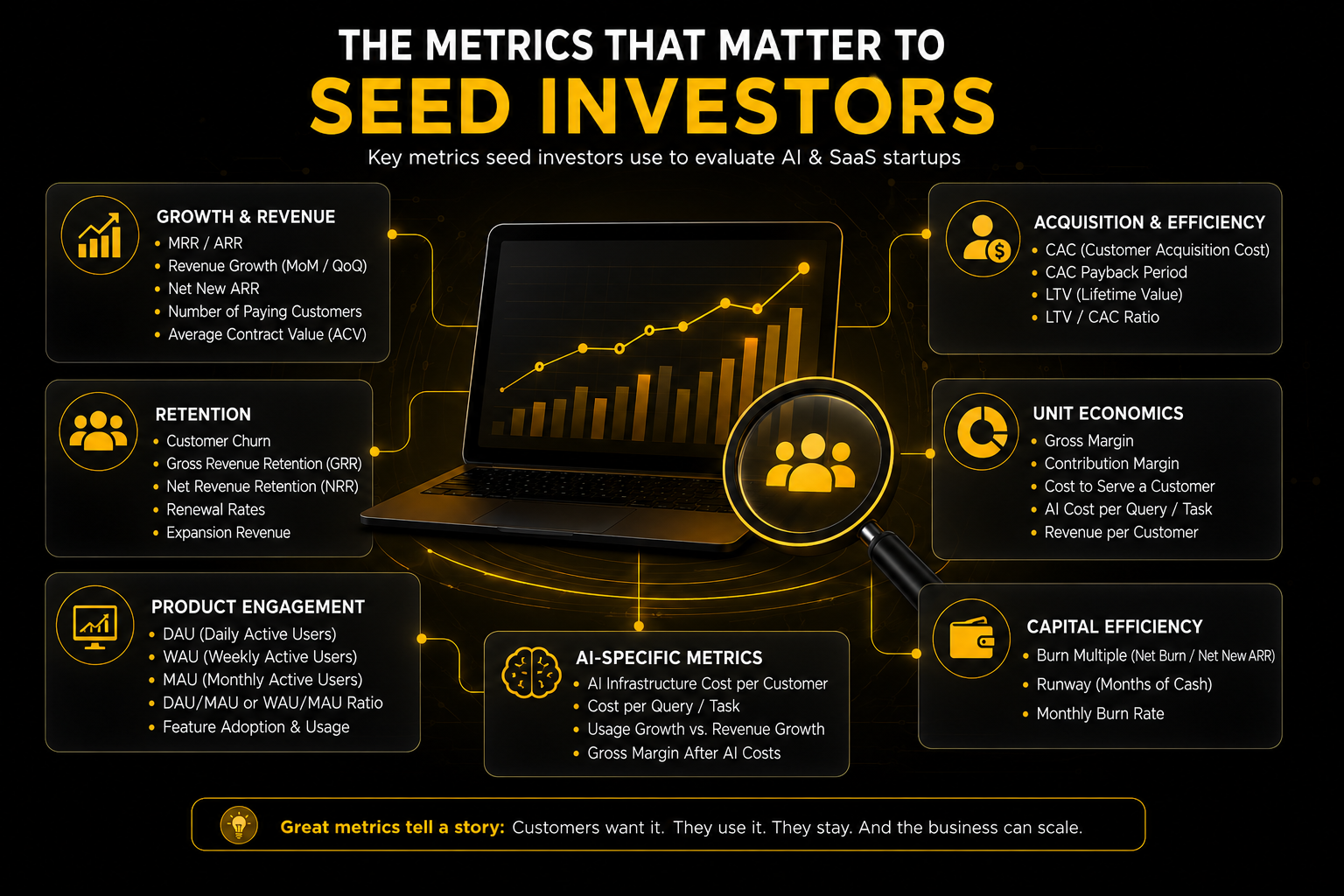
5. CAC: How Efficiently Can You Acquire Customers?
Customer Acquisition Cost (CAC) tells investors how much you spend to acquire each customer.
But the number needs context.
Investors will ask:
- Which channels bring your best customers?
- Is acquisition becoming cheaper?
- Is founder-led sales becoming repeatable?
- How does CAC compare with customer value?
A high CAC at seed stage isn’t automatically a red flag if there is a clear path toward improving efficiency.
6. CAC Payback & LTV: Does Growth Make Economic Sense?
Investors want to know whether the revenue generated by a customer can justify the cost of acquiring them.
Two important metrics are:
CAC Payback: How long it takes to recover customer acquisition costs.
LTV/CAC: The relationship between customer lifetime value and acquisition cost.
Together, they help investors understand whether growth can become economically sustainable.
7. Gross Margin: Can You Scale Profitably?
Gross margin is particularly important for AI startups.
AI products can carry significant costs from:
- LLM/API usage
- Cloud infrastructure
- GPU compute
- Data processing
- Model inference
Founders should know their cost to serve each customer and how that cost changes as usage increases.
Rapid AI usage is not necessarily good if costs grow faster than revenue.
8. Burn Multiple & Runway: Are You Using Capital Efficiently?
Investors also want to know what happens to the money they invest.
Burn Multiple = Net Cash Burn ÷ Net New ARR
A lower burn multiple generally indicates better capital efficiency.
Founders should also clearly understand:
- Monthly burn
- Cash runway
- Hiring costs
- Major expenses
- Milestones to achieve with the next round
The strongest fundraising story connects:
Capital → Milestones → Growth → Next stage
9. AI-Specific Unit Economics
For AI startups, one additional layer matters: AI economics.
Track:
- AI cost per customer
- Cost per query/task
- Revenue per customer
- AI infrastructure costs
- Gross margin after AI costs
- Usage growth vs. revenue growth
Investors want to know whether your AI business becomes more efficient as it scales—or more expensive.
Final Takeaway
Seed investors aren’t looking for perfect numbers. They’re looking for evidence of momentum and potential.
A strong AI or SaaS startup can demonstrate:
Real customers + growing revenue + strong retention + meaningful engagement + improving acquisition efficiency + sustainable unit economics.
Ultimately, your metrics should tell one clear story:
Customers want the product, they continue using it, and the business is learning how to grow efficiently.
That’s the story that turns startup metrics into an investable opportunity.

Top 10 Mistakes Early-Stage Startups Make — And How Great Founders Avoid Them
Building a startup is often romanticized as a journey driven by bold ideas and disruptive innovation. In reality, the success of most startups depends less on the originality of the idea and more on the discipline of execution.
Across global startup ecosystems, a common pattern emerges: many early-stage ventures fail not because the opportunity didn’t exist, but because critical decisions in the early stages were made without the right structure, validation, or guidance.
For founders navigating the uncertain early phase of company building, understanding these common pitfalls can dramatically improve the odds of success.
Below are ten mistakes that frequently derail early-stage startups — and the strategic approaches that successful founders adopt instead.
-
Building Before Validating the Problem
Many founders rush into product development driven by enthusiasm for their idea. However, without validating the underlying problem, even a well-built product can fail to gain traction.
✅They invest time in customer discovery
✅They engage potential users early to validate that the problem is real, urgent, and worth solving.
-
Falling in Love with the Product Instead of the Problem
Early-stage teams often become deeply attached to their solution, sometimes overlooking whether it truly addresses customer needs.
✅They maintain a problem-first mindset
✅They continuously refine the solution based on customer feedback.
-
Trying to Solve Too Many Problems
In an attempt to capture large markets quickly, startups sometimes pursue multiple use cases simultaneously, diluting their focus.
✅They begin with a narrow, well-defined problem and target segment.
✅They build traction before expanding.
-
Weak Founder Alignment
A startup’s founding team sets the tone for the entire organization. Misalignment on vision, roles, or commitment can create internal friction that slows progress.
✅They establish clear roles, shared expectations, and transparent decision-making frameworks early on.
-
Ignoring the Go-to-Market Strategy
Building a product is only one part of the equation. Without a clear strategy to reach customers, even strong products struggle to grow.
✅They think about distribution, pricing, and customer acquisition channels from the beginning.
-
Mismanaging Financial Runway
Cash flow discipline is one of the most underestimated aspects of early-stage entrepreneurship.
✅They maintain financial discipline, prioritize essential spending
✅They plan for at least 12–18 months of operational runway.
-
Hiring Without Strategic Intent
Early hires significantly influence the culture and capabilities of the startup. Hiring too quickly — or delaying critical hires — can both be damaging.
✅They focus on high-impact roles that accelerate product development and market access.
-
Resisting Feedback
Startups operate in environments of uncertainty. Ignoring feedback from customers, mentors, or market signals can prevent necessary course corrections.
✅They cultivate a learning mindset.
✅They use feedback as a strategic input for iteration.
-
Scaling Before Product–Market Fit
Premature expansion — whether through marketing spend, hiring, or geographic expansion — often leads to wasted resources.
✅They first focus on achieving strong product–market fit and repeatable customer acquisition before scaling.
-
Underestimating the Importance of Founder Commitment
Entrepreneurship is not a short-term project. It requires sustained focus, resilience, and the ability to navigate uncertainty over long periods.
✅They commit fully to the journey, understanding that endurance and consistency often determine long-term success.
The Bigger Lesson: Startups Are Built, Not Just Launched
While innovation begins with an idea, successful startups are the result of structured experimentation, disciplined execution, and strong ecosystem support.
Founders who surround themselves with the right mentors, investors, and venture-building platforms are far better positioned to avoid common pitfalls and accelerate their path to growth.
At Cultiv8, we believe startups succeed when founders are supported not just with capital, but with the right structure, expertise, and strategic guidance to build scalable companies.
Because in the end, great startups are not accidental — they are deliberately built. 🚀

The Three-Role Framework: What Makes a Venture Studio Truly Different?
The startup ecosystem is full of labels — incubator, accelerator, VC, venture builder, innovation hub.
But in the middle of all this, one term is widely used and often misunderstood:
Venture Studio
Many organizations call themselves venture studios, but only a few actually operate like one.
So what really defines a venture studio?
The answer lies in a simple but powerful concept:
the Three-Role Framework.
A true venture studio is not one thing.
It is three roles working together:
Entrepreneur + Operator + Investor
When all three roles are performed together, a venture studio becomes a startup factory — a system designed to consistently build and scale companies.
Venture Studio Framework: Why It Matters
The lack of a clear definition creates confusion:
-
- Founders don’t know what support they are truly getting
- Investors can’t compare studios fairly
- Many “studios” behave like agencies or accelerators
The Three-Role Framework brings clarity.
It separates real venture studios from those that only carry the name.
Role 1 – Entrepreneur
Where Ideas Are Born
Unlike VCs or accelerators, venture studios do not wait for startups.
They create them.
In the Entrepreneur role, the studio:
-
- Identifies real-world problems
- Studies markets and customer pain points
- Designs startup ideas internally
- Tests assumptions before building
Here, the studio acts as the original founder, shaping the vision, model, and roadmap.
This role ensures that only validated, high-potential ideas move forward.
Role 2 – Operator
Where Ideas Become Companies
Ideas alone don’t build startups — execution does.
In the Operator role, the venture studio:
-
- Builds MVPs and early products
- Provides engineering, design, and marketing
- Sets up finance, legal, HR, and systems
- Supports daily execution
This is what separates venture studios from incubators and mentors.
They don’t just advise — they build alongside the founders.
The studio becomes the first execution team until the startup is strong enough to stand alone.
Role 3 – Investor
Where Belief Is Backed by Capital
A venture studio is also a capital partner.
In the Investor role, it:
-
- Invests seed capital into its ventures
- Holds long-term equity
- Supports follow-on fundraising
- Actively manages portfolio growth
Its success is not driven by service fees, but by shared ownership and long-term value creation.
Why All Three Roles Must Exist Together
Many organizations play only one or two roles:
| Model | Entrepreneur | Operator | Investor |
| VC Firm | ❌ | ❌ | ✅ |
| Accelerator | ❌ | ⚠️ | ❌ |
| Consulting Firm | ❌ | ✅ | ❌ |
| Angel Network | ❌ | ❌ | ✅ |
| Venture Studio | ✅ | ✅ | ✅ |
Only venture studios control all three at the same time — making them faster, leaner, and more resilient than traditional startups.
The Bigger Picture
Venture studios are not just building companies.
They are building systems for company creation.
By combining:
-
- Vision (Entrepreneur)
- Execution (Operator)
- Capital (Investor)
They reduce risk, increase speed, and create a repeatable engine for innovation.
________________________________________________________________________________________________
Venture Studio Framework in Action: LaunchLite
Cultiv8, in partnership with Launch Sphere Labs, has initiated “LaunchLite – a Venture Studio Founder Sprint” focused on supporting
high-potential early-stage startups through structured validation, mentoring, and venture building support.
Get hands-on mentorship, customer validation, and a clear execution roadmap.
“We’re not looking for perfect ideas—we’re looking for committed builders.”
⚡ Only 10 startups will be shortlisted.
📅 Starts: March 2026

SaaS: Powering the Next Wave of Indian Innovation
Over the past decade, Software-as-a-Service (SaaS) has quietly become one of India’s strongest start-up success stories. From automating everyday workflows to powering billion-dollar global products, SaaS is no longer just a tech model — it’s a mindset that thrives on scalability and impact.
India is now emerging as a SaaS hub for the world, with our start-ups projected to contribute nearly $50 billion by 2030. What’s driving this? A blend of strong technical talent, cost efficiency, and the ambition to build for a global audience from day one.
The Rise of Product-Led Thinking
SaaS has shifted how founders think about business. It’s not just about selling software anymore — it’s about building experiences that evolve with customers. From AI-driven insights to hyper-personalized platforms, Indian start-ups are innovating faster than ever, targeting sectors like healthcare, logistics, and education.
Opportunities Ahead
The opportunities in SaaS are massive:
1. Vertical SaaS: Solving deep, industry-specific problems
2. AI-driven SaaS: Automating complex decision-making
3. SMB-focused SaaS: Empowering India’s small businesses to go digital
The best part? With cloud infrastructure, even a small team can now build something that serves the world.
Cultiv8’s SaaS Open Day
At Cultiv8, we believe SaaS isn’t just software — it’s the backbone of tomorrow’s digital economy.
To celebrate and strengthen this ecosystem, we’re hosting the SaaS Open Day Session in partnership with Cumma,.
Join us for:
💡 Mentor Connect with Mr. Vignesh Kumar, Founder & CEO of Paiyrgal — sharing real-world lessons on building and scaling SaaS products.
🚀 Founder Talk with Mr. Paul Jai Sudhan, Founder & CEO of Vidmagin — as he shares his journey, vision, and insights from the SaaS trenches.
📅 Date: 19 November 2025
🕒 Time: 3:00 PM – 04:30 PM
📍 Venue: Cultiv8 Office, Coimbatore
🔗 Link: Register Now
If you’re a SaaS founder, product enthusiast, or someone curious about building for scale, this is your room. Let’s learn, share, and build the future — together. 💻✨

Startup EXIT: Knowing When & How to Leave the Game
At Cultiv8, we recently hosted a workshop on Startup Exit Strategies, helping founders understand when and how to plan their exit — whether through acquisition, merger, or other strategic paths.
Why Talk About Exits?
Many entrepreneurs focus on building and scaling — but forget to plan the endgame. Whether it’s through acquisition, IPO, or even shutting down, every startup has an exit. Knowing your options and preparing early can maximize value and reduce chaos when the moment comes.
Key Takeaways from the Exit Strategy Workshop
- Not All Exits Are Created Equal:
From M&A deals to acquihires and strategic buyouts, every exit path has its pros and cons. Founders must align exit goals with their long-term vision and stakeholder expectations. - Start with the End in Mind:
Exit planning should begin as early as your startup journey. This includes having clean financials, proper documentation, and clarity on ownership (cap tables, equity structures). - Valuation Is a Moving Target:
A startup is worth what someone is willing to pay for it — but understanding valuation frameworks, revenue multiples, and investor expectations helps negotiate better deals. - Legal & Compliance Matter More Than You Think:
Poor IP protection, messy contracts, or unresolved shareholder agreements can kill a deal. Due diligence readiness is key. - Culture Survives the Exit — Or Dies With It:
In cases of acquisition, founders often forget the people factor. How your team transitions, how the brand lives on — it all matters post-exit.
Expert Sessions
Led by Mr. Sathish Ramalingam (Founder of eAuditor Office and Co-Founder of Nexub), the session included real-world stories and practical advice on identifying the right time to exit, evaluating offers, and managing investor expectations.
Final Thought
EXISTS AREN’T JUST THE END — THEY ARE A MILESTONE. Whether you’re aiming for acquisition or just exploring your options, being prepared puts you in control.
At Cultiv8, we’re here to support founders across every stage of the journey.

Think You Need Big Funding to Start a Startup? Think Again.
In a world where venture capital often steals the spotlight, bootstrapping is the unsung hero of startup success. Bootstrapped startups may not make headlines for billion-dollar rounds, but they build resilient foundations, strong customer relationships, and sustainable growth.
So before you start pitching investors, ask yourself:
What could you build if you bet on yourself first?
What is BOOTSTRAPPING?
Bootstrapping is the practice of launching and growing your startup using personal savings and reinvested early revenues, without relying on external funding. It’s a lean and disciplined approach that encourages founders to focus on building real value from day one. By prioritizing sustainable growth, customer satisfaction, and smart financial choices, bootstrapped startups often develop stronger business fundamentals — all while retaining full control and ownership.
Why Bootstrapping Matters?
- Grants the owner more control over the company- Founders retain full decision-making power without investor influence.
- Cost-saving strategies help minimize expenses- Limited funds encourage lean operations and smarter spending.
- Reduces the barrier to entry for starting a business- No need to wait for funding — you can start with what you have.
- Focuses more on optimizing business operations- Efficiency becomes a priority, leading to stronger, scalable systems.
Bootstrapping Strategies-
-
- Contribute Personal Equity: Founders invest their own capital to fund the business in its early stages.
- Incur Personal Debt: Founders may take out personal loans if business capital is low, but are personally liable.
- Cut/Avoid Costs: Limit spending by trading time for capital, like delivering goods personally to save on delivery costs.
- Form Business Relationships: Use short-term agreements or third-party financing to temporarily support operations.
- Limit Business Operations: Scale back operations (e.g., limit product offerings or geographical reach) until capital allows for expansion.
Bootstrap Success Stories in India-
- Zoho – A global SaaS company offering a suite of business tools, built without external funding.
- Zerodha – India’s leading discount stock broker, profitable from the start with zero VC backing.
- FusionCharts – A data visualization startup that grew globally by selling directly to developers.
- Wingify – Known for its product VWO (Visual Website Optimizer), built entirely through self-funding.
- Keka HR – An HR tech platform that scaled successfully by focusing on product and customer needs over funding.
Here’s when to consider external funding-
- You’ve validated your product in the market.
- There’s consistent revenue or user traction.
- Your team is ready to execute at scale.
- A well-defined growth strategy needs capital to accelerate.
THINK BEFORE YOU RAISE. BOOTSTRAP BEFORE YOU BURN.

Cultiv8 & Coimbatore Smart City: Powering Urban Innovation Through CSR
As cities across India embrace digital transformation, Coimbatore is leading the way with forward-thinking urban initiatives under the Smart City mission. At Cultiv8, we’re proud to be closely associated with this transformation, contributing not just ideas, but action. And now, we’re inviting CSR partners to be part of this impact-driven journey.
Driving Change Through Collaboration
Cultiv8 has been actively collaborating with the Coimbatore Smart City project to implement solutions that go beyond infrastructure, focusing on technology, community upliftment, and smart communication. One of our proudest milestones in this partnership has been the successful deployment of Digital Out-of-Home (DOOH) display boards across the city through our seed-funded startup, Colris Digital.
These dynamic digital boards are reshaping how the city communicates with its people. From broadcasting public safety messages and civic alerts to highlighting local events and Ads, the DOOH network is turning static spaces into real-time information hubs.
Why CSR Matters
Urban transformation isn’t just about tech—it’s about people. And to make a lasting impact, we need more than innovation; we need collaborative support from businesses and organizations that believe in giving back. That’s why Cultiv8 is actively seeking CSR funding to strengthen and scale our initiatives in alignment with the Coimbatore Smart City vision.
Let’s Build the Future Together
At Cultiv8, we see ourselves as a bridge between vision and execution. With strong roots in Coimbatore and a shared mission with Smart City authorities, we’re committed to driving meaningful, scalable impact. And with the right CSR partnerships, we can take these efforts even further—making smart, sustainable living a reality for all residents.
If you’re looking to support real change, measurable, visible, and community-centered, we’d love to talk. +91 95852 93396 | srisakthi@thecultiv8.com

The Essentials of B2B Sales, GTM, and Customer Retention
In the fast-paced world of Business-to-Business (B2B) operations, mastering sales, Go-to-Market (GTM) strategies, and customer retention is essential for long-term success. Let’s break it down:
B2B Sales Tactics:
1️⃣ Define Your Ideal Customer Profile (ICP): Pinpoint the type of businesses that benefit most from your offering to target sales efforts effectively.
2️⃣ Position Yourself as an Expert: Educate potential clients through valuable content like webinars, guides, and case studies to build credibility.
3️⃣ Tailor Your Outreach: Customize your pitch to solve specific problems for each prospect – generic sales talk won’t cut it.
4️⃣ Use Social Proof: Happy clients are powerful advocates. Showcase testimonials, referrals, and success stories to win trust.
Winning Go-to-Market (GTM) Strategy:
1️⃣ Craft a Clear Value Proposition: Communicate exactly how your product solves key pain points better than competitors.
2️⃣ Select the Right Channels: Engage where your customers are – LinkedIn, industry events, or targeted email campaigns.
3️⃣ Adapt and Improve: Track performance, gather feedback, and continuously tweak your approach for better results.
🔄 Customer Retention Made Simple:
1️⃣ Proactive Support is Key: Fast, effective help keeps clients satisfied and loyal.
2️⃣ Keep Delivering Value: Share updates, new features, and industry insights to ensure they get the most from your product.
3️⃣ Listen and Act: Customer feedback helps refine your offering and strengthens relationships.
4️⃣ Reward Long-Term Partners: Offer incentives like loyalty programs, exclusive deals, or personalized discounts to keep them coming back.
💡 The Takeaway:
B2B success relies on a smart mix of targeted sales, a strategic GTM plan, and ongoing customer engagement. Nail these fundamentals, and you’ll build lasting, profitable partnerships.
⚡ Want to master B2B strategies?
Cultiv8, a leading business incubator in Coimbatore is offering a one-day workshop that will dive deeper into these tactics and more. Stay tuned for the final date – you won’t want to miss it!

Mentor’s Role in Startup Journey
Mentorship plays a pivotal role in the success of startups, offering invaluable guidance, support, and resources that can significantly influence an entrepreneur’s journey. At Cultiv8, we recognize the transformative power of mentorship and are committed to fostering meaningful mentor-mentee relationships to drive startup success.
The Impact of Mentorship on Startups
- Expert Guidance and Experience
Mentors bring a wealth of experience and industry insights, helping startups navigate challenges and make informed decisions. Their guidance can accelerate learning curves and prevent common pitfalls. - Networking Opportunities
Through mentors, startups gain access to extensive professional networks, opening doors to potential investors, partners, and customers. This connectivity is crucial for business growth and expansion. - Emotional Support and Confidence Building
The entrepreneurial journey is fraught with uncertainties. Mentors provide emotional support, boosting the confidence of founders and helping them stay resilient in the face of adversity. - Skill Development
Mentorship facilitates the development of both hard and soft skills, from strategic planning and financial management to leadership and communication. This holistic growth is essential for long-term success.
Connect with Cultiv8 for Mentor Consultations
At Cultiv8, we offer personalized mentor consultations to connect startups with seasoned professionals who are passionate about nurturing the next generation of entrepreneurs. Our mentors offer:
- Personalized Guidance: Tailored advice that aligns with the unique needs and goals of each startup.
- Strategic Planning: Assistance in developing robust business strategies and refining business models.
- Accountability: Regular check-ins to ensure startups stay on track with their objectives and milestones.
Meet Our Esteemed Mentors
We are proud to have a diverse panel of mentors at Cultiv8.
For a comprehensive list of our mentors and their profiles, visit our Mentors community.
If you’re a startup seeking guidance or a professional eager to mentor emerging entrepreneurs, we invite you to schedule a mentor consultation with Cultiv8. Our mentors are dedicated to empowering you with the insights and strategies needed to achieve your business goals.
For more information and to get involved, contact us – +91 86103 50163 | business@thecultiv8.com

Why Sustainability Matters: Building a Better Future
Why Sustainability Matters: Building a Better Future
In today’s world, sustainability is no longer a choice but a necessity. With increasing concerns about climate change, resource depletion, and environmental degradation, embracing sustainability has become essential for preserving our planet and securing a better future for generations to come. Sustainability is not just about environmental preservation; it’s about creating a balanced approach to economic growth, social equity, and ecological responsibility.
The Triple Bottom Line of Sustainability
At its core, sustainability focuses on three interconnected pillars:
1. *Environmental Protection*: Ensuring that our natural resources, such as water, air, and biodiversity, are conserved for future generations by reducing pollution, waste, and carbon emissions.
2. *Economic Viability*: Promoting business practices that are efficient, responsible, and long-term, ensuring steady growth without exploiting natural or human resources.
3. *Social Equity*: Creating inclusive societies where all individuals have access to basic needs, education, and opportunities, while promoting ethical practices and fair treatment.
Why Is Sustainability Important?
1. *Mitigating Climate Change*: Global warming is a pressing issue, with rising temperatures, melting ice caps, and erratic weather patterns affecting millions. Adopting sustainable practices like reducing greenhouse gas emissions and shifting to renewable energy can curb these effects.
2. *Preserving Resources*: Earth’s resources, like water and fossil fuels, are finite. Sustainability ensures the responsible use of these resources, focusing on renewable alternatives and circular economies.
3. *Enhancing Quality of Life*: Sustainability promotes a healthier environment, clean air, and better living conditions, improving overall quality of life for individuals and communities.
4. *Driving Innovation*: The push for sustainability often sparks innovation, leading to the development of eco-friendly technologies, sustainable products, and resource-efficient processes.
5. *Economic Stability*: Sustainable practices reduce long-term costs, improve efficiency, and build resilient businesses, ensuring steady economic growth even in the face of challenges.
Practical Steps Toward Sustainability
Sustainability starts with individual and collective actions. Here’s how everyone can contribute:
– *Reduce, Reuse, Recycle*: Minimizing waste and reusing materials helps conserve resources and reduce pollution.
– *Adopt Renewable Energy*: Transitioning to solar, wind, or other renewable sources minimizes reliance on fossil fuels.
– *Practice Responsible Consumption*: Supporting brands and businesses that prioritize sustainable practices drives positive change.
– *Embrace Green Technologies*: From electric vehicles to energy-efficient appliances, small steps can make a big difference.
– *Raise Awareness*: Educating communities about sustainability’s importance fosters a culture of accountability and change.
Sustainability and Business
For businesses, sustainability is more than a trend; it’s a strategic imperative. Companies that embrace sustainability not only gain consumer trust but also future-proof their operations. Sustainable businesses are better positioned to manage risks, reduce costs, and stay competitive in a market increasingly driven by eco-conscious consumers.
Creating a Collective Impact
Sustainability is a shared responsibility. Governments, businesses, and individuals must work together to build systems and policies that prioritize environmental and social wellbeing. By adopting sustainable practices, we can collectively address challenges like deforestation, plastic pollution, and climate change.
At its heart, sustainability is about creating harmony between people, the planet, and prosperity. Each small step we take contributes to a larger, impactful change.
*At Cultiv8, we believe in fostering innovation that aligns with sustainability goals.* Together, let’s create solutions that not only succeed but also make the world a better place for future generations.